How Much Do Ivy League Schools Value Application Essays?
Seven Ivies put essays in their highest category. Read Harvard’s rating in context and see how the questions differ across campuses.
Updated
This guide is about the US Common App Personal Statement; for the UK UCAS format, see How to Write the UCAS Three Questions.
On this page
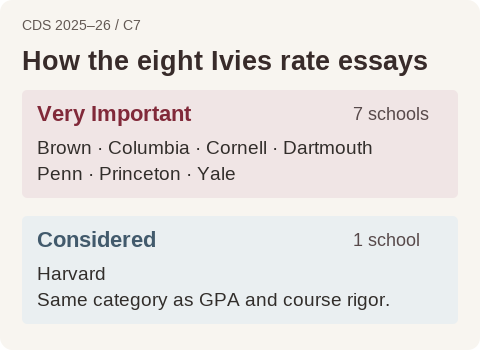
Seven of the eight Ivy League schools rated the application essay Very Important in their 2025–26 Common Data Sets. Harvard selected Considered. Read across Harvard’s table before drawing a conclusion: it placed high school course rigor and GPA in the same category as the essay. Harvard’s report
How to read section C7
The data below refer to the entering class of fall 2025. Section C7 asks how much each factor matters in general first-year admission. Schools choose from Very Important, Important, Considered and Not Considered. There is one row for the application essay, with no percentage split or separate ratings for the Common App essay and supplements. The school examples that follow use guidance available for the 2026–27 application cycle. Official CDS questionnaire
| University | Essay | Course rigor | GPA | Source |
|---|---|---|---|---|
| Harvard | Considered | Considered | Considered | CDS |
| Yale | Very Important | Very Important | Very Important | CDS |
| Princeton | Very Important | Very Important | Very Important | CDS |
| Columbia | Very Important | Very Important | Very Important | CDS |
| Brown | Very Important | Very Important | Very Important | CDS · Archived report |
| Dartmouth | Very Important | Very Important | Very Important | CDS |
| Penn | Very Important | Very Important | Very Important | CDS |
| Cornell | Very Important | Very Important | Important | CDS |
Columbia’s figures cover Columbia College and Columbia Engineering. General Studies reports separately. Cornell lists essays and course rigor in its highest category and GPA one category below. C7 does not quantify how a particular essay might affect an individual decision. Columbia reports · Cornell reports
Harvard and the context behind an activity
Harvard’s short answers give applicants space to explain how their experiences shaped them and how they engage with others. Suppose your activities list already says you work twelve hours a week at your family’s restaurant. A short answer could describe the first time your family trusted you to handle a customer complaint alone. The hours tell a reader how much time you gave. The phone call tells them what you were trusted to do. Application tips
Yale and the writer’s point of view
Yale’s readers say they have read wonderful essays on ordinary subjects and weak ones on unusual subjects. The difference often lies in what the writer noticed. Yale also describes its reading process: the initial assessment covers the transcript, testing, activities and honors. Essays and recommendations may be consulted when further evaluation is needed; the full review considers all application documents. On a second reading of your own essay, ask what someone could say about your thinking after they have summarized the event. Essay advice · Essay advice – selection process
Princeton and a piece of classroom writing
Princeton asks for a graded written paper from a secondary-school course. The instructions favor thesis-driven analytical writing and ask for the grade and any teacher comments. A personal essay might trace how you changed your mind. A classroom paper lets a reader examine how you advanced a claim, weighed evidence and reached a conclusion. When choosing the paper, reread the teacher’s comments alongside your work. A short, well-argued piece can give the reader plenty to consider. Graded paper guidelines · Graded paper guidelines – supplemental questions
Columbia and the things you read outside class
Columbia asks for a list of texts, resources and outlets that shaped your intellectual development outside school. Books, exhibitions and podcasts can all belong there. A student fascinated by public transit might include an urban planning book alongside the local transit hearings they watch every month. The hearings tell a reader something specific about how the student spends their time. Follow the current prompt for the list format. Columbia questions · Columbia questions – prompt reference
Brown and a question worth designing a course of study around
Brown’s Open Curriculum gives students the freedom and responsibility to shape a course of study. Its admissions office recognizes that interests can still be developing. Imagine a student who scores films. Changing when a melody first appears changes how viewers judge a character. Did the music alter their attention, memory or emotional response? Now a course in experimental design has a purpose in this student’s account. The reader can see why music, psychology and statistics belong in the same paragraph. Open Curriculum · Open Curriculum – academic interests
Dartmouth and the classmate others would meet
Dartmouth separates the question about fit from prompts inviting applicants to introduce themselves. One response might explain the kind of study group you hope to join. Another could show how you behave in the group you already have. When a discussion stalls, do you speak first, or return to an unfinished question from a quieter student? Either detail helps a future classmate picture working with you. Writing supplement
Penn and the person receiving the thank-you note
Penn invites you to write to someone you have yet to thank and encourages you to share the note when possible. That gives you a practical editing question: would the recipient recognize the moment you remember? Recalling why someone stayed ten minutes after rehearsal, and what their help made possible, can say more than an account of the prize you later won. Penn’s community and school-specific questions give your own academic plans room elsewhere. Writing requirements · Writing requirements – thank-you note FAQ
Cornell and the college asking the question
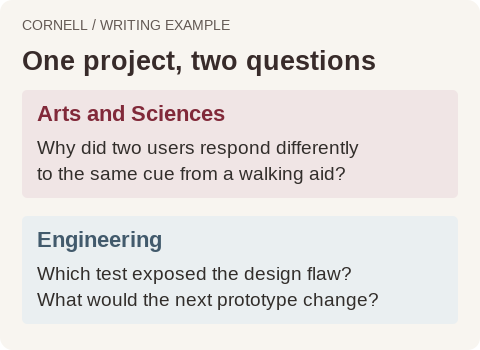
Cornell reports one institution-wide essay rating, while its writing prompts vary by undergraduate college. Arts and Sciences asks about a question that has captured your attention and how its curriculum might help you explore it. Engineering asks why you want to study engineering and why Cornell Engineering appeals to you. Consider a student who tested a walking aid. One response might follow an unexpected difference in how users interpreted a cue. Another might start with the test that exposed a design flaw. Which detail belongs depends on the question and what the student actually wants to investigate. College-specific prompts
Editing across schools
Read each draft beside your activities list and finish this sentence: After reading this piece, an admission officer will also know… If three answers lead back to the same achievement, redistribute the evidence. A decision you had to make, a conversation that changed the team and a technical question left open can each give a different essay something to say.
When a draft is ready, a public sample report shows how psgrader connects its reading to specific sentences. The ratings describe what a school values; whether a particular essay is clear is a question about the writing itself. The student remains responsible for every factual claim and for the final wording.
FAQ
Does C7 say what share of the decision the essay carries?
C7 uses four qualitative categories and a single application essay row. It does not publish a separate share for the personal essay or for supplements, and the rating cannot be converted into an effect on an individual decision.
Harvard marked the essay Considered. Does that mean essays matter less there?
In the same C7 table, Harvard placed course rigor and GPA in the Considered category, while the other seven schools rated the application essay Very Important; their GPA categories differ. The four-level scale describes where a factor sits in the overall review; it does not translate into a share for one essay. Harvard's application guide still explains what its short answers are for.
Can one personal essay serve all eight applications?
The Common App personal essay is written once and read by all eight schools. Supplements answer each school's own questions and are written separately, and Princeton additionally asks for a graded piece of classroom writing; check the school's requirements for what to submit.
Continue reading
Explore sample reports
Want to see what a full essay evaluation looks like? Browse a public sample first.
Explore sample reports